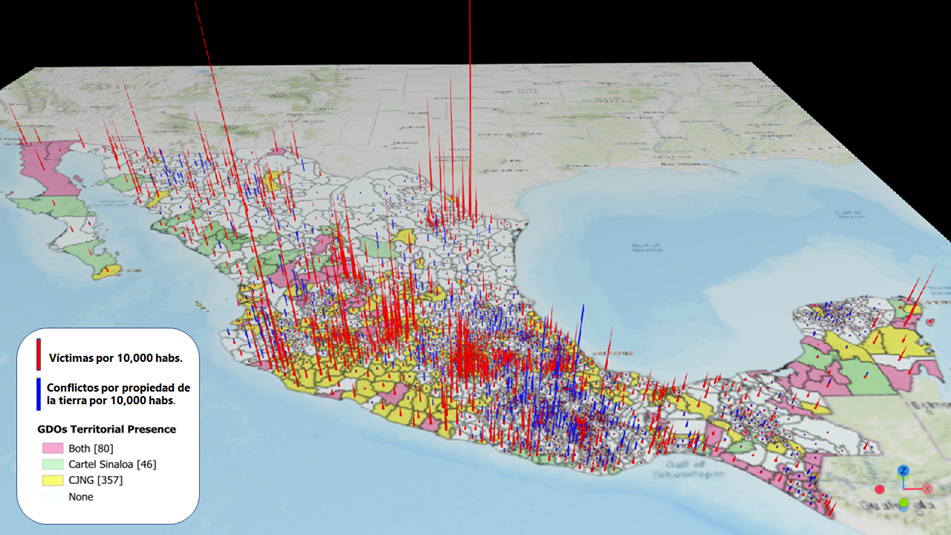
Cartels Inc.: A New Generation of Criminal Networks is a research project led by Guadalupe Correa-Cabrera at the Corruption, Networks, and Transnational Crime Research Center. The project examines how organized crime in Mexico and the Americas has evolved from hierarchical “cartels” into decentralized, adaptive networks that operate across licit and illicit economies.
Challenging conventional narratives, the project conceptualizes contemporary criminal organizations as flexible, networked systems—often resembling franchise models—shaped by global markets, state policies, and security strategies. It pays particular attention to the intersection of organized crime with (para)militarization, energy sectors, and natural resource extraction, including hydrocarbons, lithium, and water.
Methodologically, the project combines qualitative fieldwork with computational approaches such as network analysis and machine learning to map relationships among actors, territories, and economic activities. Empirical focus areas include key regions of Mexico and transnational corridors linked to broader hemispheric dynamics.
By reframing organized crime as a complex adaptive system, Cartels Inc. contributes to academic and policy debates on security, governance, and illicit economies, while providing new tools to understand—and more effectively address—violence in the Americas.