
Co-Directors
Guadalupe Correa-Cabrera
Professor
[email protected]
Office: 703-993-6273
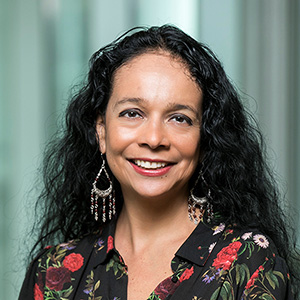
Guadalupe Correa-Cabrera’s areas of expertise include border studies, U.S.–Mexico relations, international security, migration studies, and illicit networks. She is the author of Los Zetas Inc.: Criminal Corporations, Energy, and Civil War in Mexico (2017; Spanish edition, 2018) and co-author of Frontera: A Journey across the U.S.–Mexico Border (2024). Her forthcoming book in Spanish, Cartels Inc: A “New Generation” of Criminal Networks (2025), is under contract with Siglo XXI Editores.
Correa-Cabrera is past president of the Association for Borderlands Studies and co-editor of International Studies Perspectives. A former Fulbright U.S. Scholar in Mexico, she was a visiting scholar at El Colegio de la Frontera Norte in Tijuana in 2014–2015 and was a distinguished visiting scholar at Dartmouth College’s Davidson Institute for Global Security in fall 2025. She also frequently comments in the media on Mexican politics, U.S.–Mexico relations, (im)migration, and border security.
View Correa-Cabrera’s full bio.

Naoru Koizumi
Associate Dean of Research and Grants, Omer L. and Nancy Hirst Endowed Chair
[email protected]
Office: 703-993-8380
Dr. Naoru Koizumi is a Professor and the Associate Dean for Research at Schar School of Policy and Government at George Mason University (Schar School). Her work intersects public policy, systems engineering, and health/medical ethics, with particular interests in kidney transplantation policy and global kidney trade networks and trafficking. She is currently leading an NSF-funded project called “Evolution of Global Illicit Kidney Trade Networks: Identification, Reconstruction, and Disruption” that aims to build a modeling framework that captures how these illegal kidney networks form, evolve, and can be disrupted. By modeling network evolution, she and her team hope to identify patterns/behaviors common to organ trafficking and design intervention strategies. Under this award, she has published several articles on data-driven identification of global organ trade listed below. In these works, she and her team utilize quantitative methods including: 1) social network analysis (SNA) to analyze the structure of the notorious kidney sales cases known as “Medicus case” from the court materials; 2) the Network Scale-Up Method (NSUM) to estimate how widespread kidney trafficking is in Kalai Upazila, Bangladesh; and 3) AI / large language models (LLMs) + retrieval-augmented generation (RAG) to extract geographic locations of illicit kidney trade from texts in news articles.

Janine R. Wedel
Distinguished University Professor
[email protected]
Office: 703-993-3567
Janine R. Wedel is an award-winning author who writes about elite influence, power networks, shadow elites, and weaponized corruption in the United States, Central and Eastern Europe, Russia, and Ukraine, drawing on her perspective as a social anthropologist.
Her books include the forthcoming Elite Influence: Everything You Need to Know (Oxford University Press); Unaccountable: How Elite Power Brokers Corrupt Our Finances, Freedom, and Security (Pegasus, updated 2016); Shadow Elite: How the World’s New Power Brokers Undermine Democracy, Government, and the Free Market (Basic Books, 2009); and Collision and Collusion: The Strange Case of Western Aid to Eastern Europe (Palgrave Macmillan, 2001).
She has written for more than a dozen major news outlets, including The New York Times and Financial Times, and has received awards from the National Science Foundation, the MacArthur Foundation, and the Carnegie Corporation of New York, among others.